
Maybe you choose healthier foods most of the time.
You don’t feel like you’re overeating.
You only treat yourself to something sweet occasionally.
And you exercise regularly.
Yet your body shape isn’t quite what you expected.
And the scale hasn’t moved for weeks.
Very often, the problem isn’t your meals—it’s everything that happens between them.
And no, that doesn’t mean you’re doing anything “wrong”.
It simply means you may not be aware of hidden calories.
And you’re certainly not alone.
What does that mean?
The last few kilos are rarely a matter of motivation or discipline—they’re usually a matter of precision.
When a woman has 10–15 kg to lose and has spent years being inactive and not paying much attention to nutrition, her body often responds quickly once she starts making changes. She chooses healthier foods, moves a little more, starts exercising, and can still enjoy dessert from time to time because she’s already doing far better than before.
But when you’re already doing most things “right” and only have the last 2–5 kilos left to lose, those are often the hardest.
And as unfair as it may seem, it can sometimes be easier for someone who has never focused on their health to lose 10 kilos than it is for me to lose 1—or for you to lose 3.
Because by then, you’ve already changed almost everything you could.
That’s when small details start making a big difference.
And those details deserve your attention.
Little by little, it may be worth looking at:
- A little extra milk in your coffee
- A “healthy” drink
- A protein snack that isn’t really just a snack
- The healthy olive oil in your salad
- Hidden sugars
The problem is that most women don’t think of these things as food.
But by the end of the day, they still count.
Drinks are often the biggest weight-loss saboteurs (because we don’t take them seriously)
Yesterday, I came across an advert for a protein matcha drink.
It looked great.
Protein.
Matcha.
What’s not to like?
It sounded healthy.
It looked completely “fitness approved”.
But when I checked the nutrition label:
30 g of protein.
27 g of sugar.
Around 300 calories in total.
The same applies to many matcha drinks and coffees you order in cafés.
You choose a coffee or matcha with plant-based milk because it seems like the healthier option.
But:
- Many plant-based milks contain 7–8 g of sugar per 100 ml
- A 250 ml serving can easily provide around 20 g of sugar
- Plus additional calories from fats
Suddenly, you have a drink that:
- Didn’t keep you full
- Caused a significant blood sugar response
- Used up as many calories as a meal—without actually feeling like one
The same applies to:
- Smoothies
- Ready-made protein shakes (which often contain as many carbohydrates as protein)
- Flavoured coffees
- Protein bars—which may seem healthier than regular chocolate bars but can still contain a substantial amount of carbohydrates alongside the protein
Even when those carbohydrates aren’t simple sugars, they still contribute to your overall intake.
A “high protein” label doesn’t automatically make something a good choice.
Sometimes it’s not a healthy snack at all.
It’s simply a calorie-dense product packaged as a healthier option.
One day it’s that snack.
The next day it’s a biscuit with your coffee.
The day after, it’s a little extra olive oil on your salad.
Nothing dramatic.
You’re still generally eating well.
And then, a few months later, you’ve gained 3 kilos and feel like your body isn’t responding to your efforts at all.
Why does your body seem to stall at that point?
Because when you’ve been living a certain way for a long time:
- Your metabolism becomes more sensitive
- Hormonal responses change over time, particularly for women over 35
- Progress often requires more analysis and fine-tuning
- It becomes easier to overtrain and harder to recover properly
And at that point, the answer is not to eat even less.
The answer is not to skip dinner.
The answer is not to train even harder.
The answer is to take a closer look at what you’re consuming without even realising it.
What can you do today (without counting calories)?
You don’t need another app.
You need awareness.
Ask yourself a few simple questions:
1. What do I drink every day that I don’t consider food?
2. Does my “protein” snack contain more sugar than protein?
3. Am I regularly drinking something that contains calories?
4. How often do I choose something because it seems “healthy” without checking the nutrition label?
5. And if I do read the label, do I actually understand what it means for me?
If you’re going to consume calories, it’s usually better to chew them.
A banana and a protein pudding will keep you fuller than a sugary protein matcha.
If you’re struggling with those last few kilos, it’s not because you’re lazy.
It’s not because you lack discipline.
And it’s not because you’re “not trying hard enough”.
More often, it’s because:
- You’re doing 80% of things really well
- The remaining 20% is happening automatically and without much awareness
And it’s often that final 20% that makes the difference when you’re aiming for a specific result.
The solution isn’t restriction or eliminating foods.
The solution is understanding what your body actually needs.
And recognising when something that seems helpful may actually be working against you.
If you’ve read this article all the way through, take a moment to go through the checklist below and see whether any of these habits appear in your daily routine.
And if you recognise yourself in some of them, there’s no guilt and no need to cut everything out.
Simply decide what fits your current lifestyle and goals.

DRINKS
Question: Does this drink keep me full like a real meal, or is it simply adding calories to my day?
And how many times per week does it appear in your routine?
- Coffee with plant-based milk (almond, oat, soy)
- Matcha latte
- Ready-made protein shakes
- Smoothies (with too much fruit and not enough vegetables)
- “No added sugar” juices (that still contain carbohydrates naturally present in fruit)
- Weekend alcohol (“just one glass of wine”)
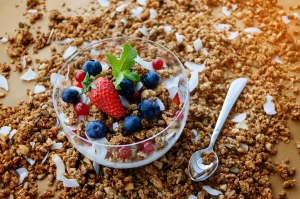
“HEALTHY” SNACKS THAT STILL CONTAIN CALORIES
Question: How much sugar is in one serving?
If it’s close to—or higher than—the amount of protein, it may not be the best choice.
- Flavoured yoghurts
- Granola and muesli
- Instant flavoured oatmeal
- Energy bars and protein bars
- “No sugar” desserts
- Spreads labelled as “high protein”
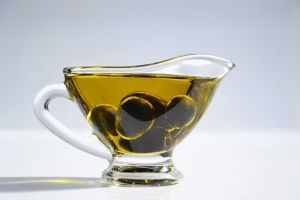
OILS AND SAUCES
Question: Do I know how many calories this contains? And what the weekly total actually adds up to?
If you’re unsure—or if the total exceeds 500 calories per week—you may have found your answer.
- Olive oil in salads (without measuring portions)
- Pesto, hummus and sauces
- Butter or olive oil used for cooking “by eye”
- Seeds and nuts eaten straight from the packet
- Cheese added to meals (Parmesan, feta, mozzarella)
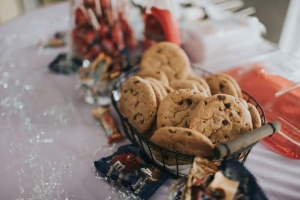
SNACKING WE “DON’T COUNT”
Question: Is this a conscious choice or something I do automatically?
Automatic eating is one of the most common reasons for weight-loss plateaus.
- Just one biscuit
- A bite from your child’s plate
- A few bites while cooking
- A little chocolate after lunch
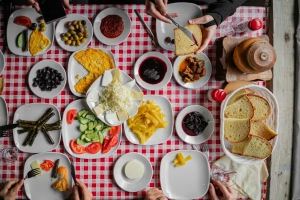
PORTIONS THAT ARE LARGER THAN YOU ACTUALLY NEED
Question: Is this portion tailored to me, or is it simply a standard serving?
- Extra milk in your coffee
- A calorie-dense dressing on an otherwise healthy salad
- A restaurant meal—chicken and rice—but the portion is designed for both a 100 kg man and you. Half of that rice may be unnecessary for your needs
- A side dish with lunch—potatoes, sweet potatoes or pasta—plus an extra slice of bread
- Healthy takeaway meals with oversized portions
If you checked three or more items:
- You don’t need to eat less
- You don’t need to skip meals
- You don’t need to train harder
You simply need to become more aware of the things you may not have been paying attention to.
Those final kilos don’t require stricter rules.
They require honesty, awareness and a clear strategy.